
What is ink marbling art, and why does it still matter?
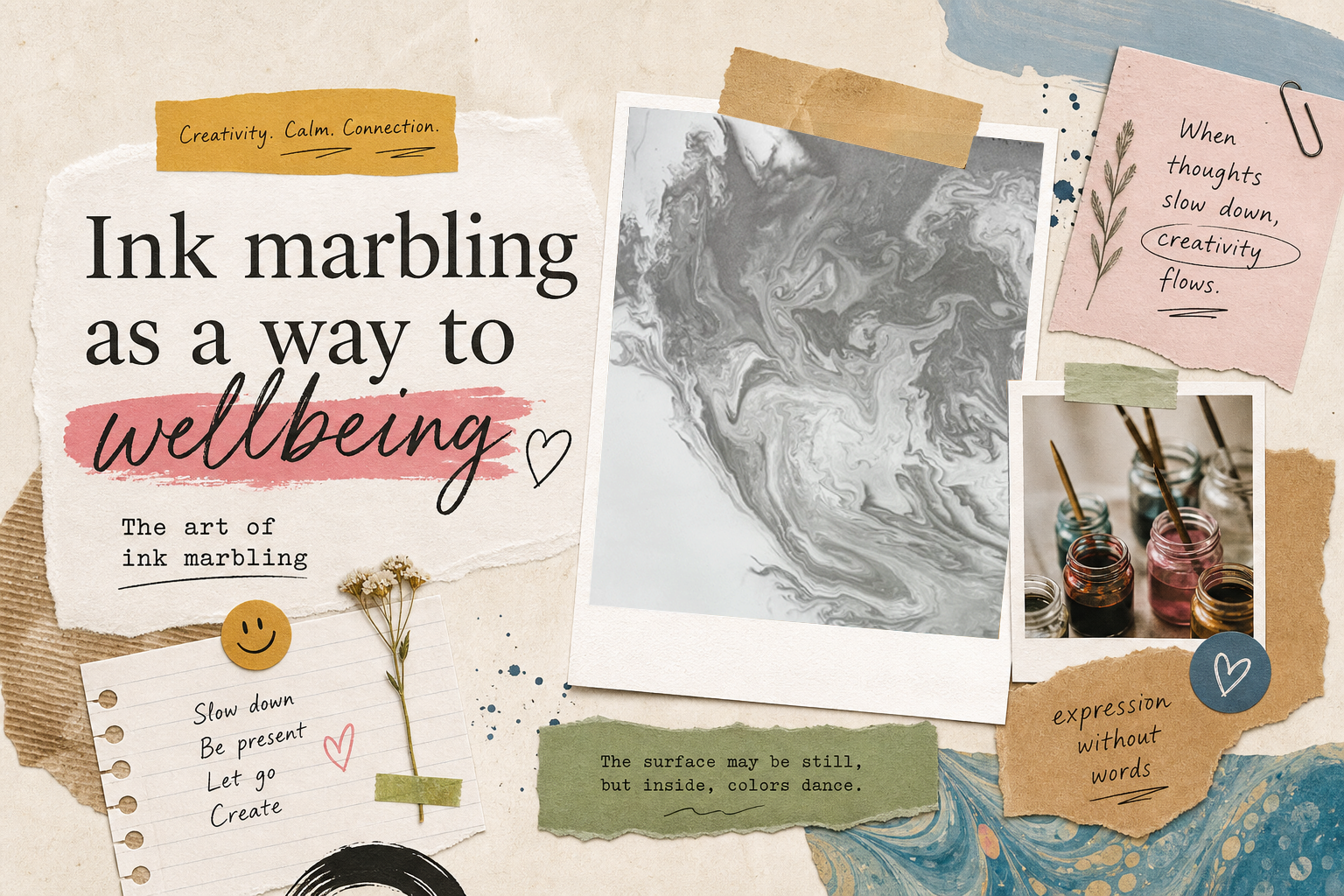
Ink marbling art has a way of stopping you cold. Picture this: you're browsing a secondhand bookshop and you pull an old volume from the shelf. The cover is unremarkable, but when you open it, the endpapers catch you completely. They're swirling in patterns that look almost alive, like oil on a moving puddle or aerial photographs of river deltas you've never visited. You stand there holding the book and think: how did someone make this?
That question stayed with me for years. The answer turned out to be deceptively simple in its mechanics and genuinely profound in its implications. Ink marbling, at its core, is the practice of floating pigment on a liquid surface, shaping it with tools or breath, and then transferring the resulting pattern onto paper or fabric. The liquid does half the work. That's the part that changes everything once you understand it.
What I didn't expect, when I started pulling on this thread, was how far back it goes and how widely the technique spread across cultures. From 12th-century Japanese court poetry to Ottoman bookbinders to contemporary artists like Prasad Beaven, Contemporary Ink Landscapes, whose fluid ink landscape paintings carry this tradition into entirely new philosophical territory, the story of marbling is not a footnote in art history. It is a window into something fundamental about how humans relate to natural process.
What ink marbling art actually is
The floating surface: how ink stays on water
The core mechanism is this: pigment mixed with a dispersant floats on a water surface. For the Japanese suminagashi tradition, plain water is sufficient. For Turkish ebru and modern acrylic marbling, the bath is thickened, usually with carrageenan or methylcellulose, to hold the paint more stably on the surface. The thickener acts like a slow-motion pause button, keeping the ink exactly where the artist places it, long enough for a full transfer.
A useful analogy is the rainbow sheen on a wet street after rain. The colours move and shift, responding to any disturbance. The difference with marbling is that this apparent chaos is intentional, shaped, and captured before it disappears. The tray of thickened water is, in effect, a canvas before the canvas.
Why no two marbled pieces can be identical
This is where the technique becomes philosophically interesting. The patterns that form on the marbling surface are real-time responses to dozens of variables: room temperature, humidity, paint viscosity, the speed and angle of every tool movement, and, in suminagashi, the artist's own breath. Change any one of these and the pattern changes completely.
This irreproducibility is not a flaw in the process. It is the process. The artist sets conditions and then enters a negotiation with physics. Control is real but always partial, and the most compelling results tend to come from practitioners who understand that distinction deeply rather than fighting against it.
Suminagashi: the Japanese art of floating ink
Origins in 12th-century Japan and its ceremonial character
Suminagashi, which translates literally as "floating ink," is one of the oldest documented forms of paper marbling. The earliest surviving examples appear in the Sanjuurokuninshuu, a poetry anthology compiled in the early 12th century for Emperor Toba, placing this tradition over nine hundred years old. Textual references go back even further, to around 825 CE, though no physical examples from that period survive.
The materials were minimal and the practice was serious. Sumi ink and a natural dispersant, often ox bile or a soap solution, were applied to still, plain water with no thickener and no elaborate preparation. For the Heian court, marbled paper was used for calligraphy, poetry, and religious documents. It was not decorative in a casual sense; it marked a meeting point between natural process and human expression, and for over four centuries its production was restricted to the Imperial Household and nobility.
How breath and the brush create the pattern
The technique works through careful alternation. The artist uses two brushes, one loaded with ink and one with dispersant, touching the water surface in turn to build concentric rings. With each touch, the ring expands outward. Blowing gently across the surface moves the rings into flowing veins and curves, and the pattern responds to breath as directly as it responds to any tool.
This responsiveness has a meditative quality that teachers of suminagashi consistently describe as central to the experience. Nothing about the practice allows for distracted work. The room needs to be still, the hand needs to be steady, and the relationship with the surface needs to be genuinely attentive. These are not background conditions; they are the practice itself.
Ebru and the Ottoman tradition of marbled paper
The thickened bath and what it makes possible
Turkish ebru brought a key technical innovation: the marbling bath. By thickening water with gum tragacanth or carrageenan, Ottoman artists created a surface that held pigment far more stably than plain water. This meant bolder, more saturated colours, more complex comb and stylus patterns, and the ability to hold a composition long enough for a clean, full transfer to paper or fabric.
The vocabulary that developed within ebru tells you something about how seriously it was taken as a discipline. Pattern names like çiçekli (floral) and bülbül yuvası (nightingale's nest) describe specific, repeatable forms with their own conventions and histories. This is not the vocabulary of accident; it is the vocabulary of a fully developed artistic tradition with masters, students, and accumulated knowledge passed across generations.
For practical notes on preparing paper and managing the bath, many contemporary practitioners consult focused how-to resources on preparing paper for marbling and similar technique guides.
How Turkish marbling spread into European books
The route into European culture ran through trade. Ottoman bookbinders introduced marbled papers to Venetian merchants in the 16th century, and from Venice the technique moved north and west. By the 17th century, European bookbinders across Germany, France, and Holland were producing their own versions of Turkish-style marbled papers for luxury volumes.
Those beautiful swirling endpapers inside 17th and 18th century European books were frequently influenced by ebru. The pattern travelled further than most of the books it decorated, and it carried a question with it wherever it went: when does a beautiful background become the artwork itself?
Ink marbling art: from decoration to fine art
When marbling stopped being the background
For most of its history, marbled paper was in service of something else. It dressed up a binding, lined a box, decorated a letterhead. The pattern was a means, not an end. This began to shift gradually, and the 20th century accelerated that shift considerably.
Abstract Expressionism opened space for process-led, chance-embracing work. The drip, the pour, the float became legitimate artistic statements rather than preparation for something more serious. Marbling art, with its fundamental reliance on controlled chance and its refusal to be exactly repeated, was philosophically aligned with this shift. Artists started asking not "what can I decorate with this?" but "what does this process itself say?"\
The philosophical turn: impermanence, process, and meaning
The most interesting contemporary artists working with marbling techniques are interested in what the form argues as much as what it shows. The ephemeral floating surface, the irreversible transfer, the patterns that echo topographic maps and atmospheric photographs: these aren't accidents of the medium. They're invitations to think about the relationship between human intention and natural process.
When you work with a marbling bath, you make decisions, but you don't make the outcome. The bath is a collaborator, not a passive tool. That distinction matters enormously, and the artists who understand it tend to produce work that carries genuine weight beyond its visual appeal.
Where the tradition leads: Prasad Beaven and contemplative ink art
Merging Daoist philosophy with fluid ink technique
This is where the historical thread arrives at something genuinely contemporary. Landscape Artist of the Year, Your Site Title, working within the tradition of fluid ink landscapes, approaches marbling technique not as a source of beautiful surfaces but as a means of exploring the relationship between outer natural worlds and inner psychological states. The flowing ink becomes a map of both simultaneously, a different ambition entirely from decoration.
The Daoist underpinning is central to this approach. In Daoist thought, the ideal is to act in harmony with natural forces rather than to override them, the principle of wu wei, or effortless action. Marbling enacts this principle materially. The artist sets conditions, introduces pigment, and then enters a genuine collaboration with the medium. The bath is not passive; it responds, resists, and surprises. In Beaven's work, this is not a technique choice. It is a philosophical commitment made visible.
What separates decorative marbling from contemplative fine art
The distinction worth drawing here is this: decorative marbling asks how beautiful a pattern can be. Contemplative marbling asks what the pattern reveals. In About | Explore Artistic Journeys — Discover More — Your Site Title's ink landscape paintings, the marbled movement becomes terrain and atmosphere, the suggestion of mountains, water, and distance. There is also an interpretive dimension worth considering: the forms that emerge from the floating surface can carry psychological weight in the way archetypes do, feeling familiar before you can explain why.
This is the question worth sitting with: when ink moves freely on water and we recognise landscapes in it, are we making the image, or discovering something that was already there? The answer, I suspect, is both. And that ambiguity is precisely why this tradition has endured for close to nine hundred years and still has somewhere meaningful to go.
The long answer to a short question
Return to that secondhand bookshop, that moment of stopping over swirling endpapers. The question that started there has a long answer: the 12th-century Japanese court tradition, Ottoman bookbinders refining their thickened baths, Venetian traders carrying the technique west, European printers incorporating it into luxury volumes, and eventually artists asking whether the pattern itself deserves to be the work.
The through-line across all of this is not technique. It's the relationship between control and surrender. Every marbling tradition, from suminagashi to ebru to contemporary ink painting, asks the artist to act and then release, to decide and then accept. That negotiation between human intention and natural force is not unique to marbling, but few techniques make it quite so visible or so honest.
If ink marbling art interests you, pay attention to the artists who are carrying it forward. Notice how the conversation shifts when a practitioner like Prasad Beaven, Contemporary Ink Landscapes brings Daoist philosophy, serious material practice, and a considered ink landscape vision to the same floating surface that Heian court poets used for their poetry anthologies. For practical tips and common fixes when you try the technique yourself, resources on marbling troubleshooting and the broader art history of paper marbling provide useful context and hands-on guidance.